The Chosen Wars by Steven R. Weisman
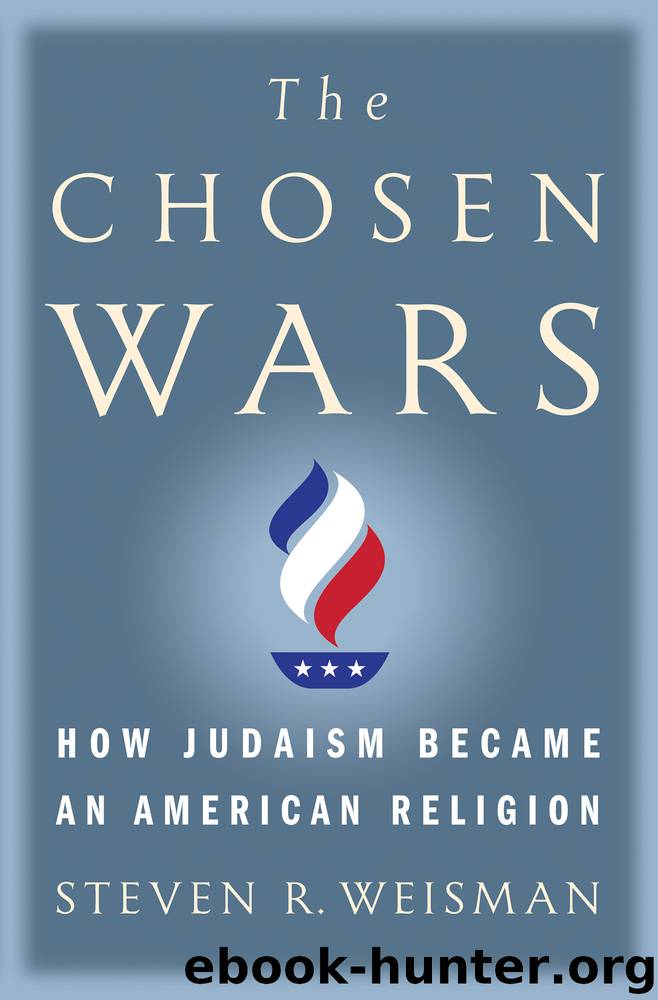
Author:Steven R. Weisman
Language: eng
Format: epub
Publisher: Simon & Schuster
SERMONS IN CONFLICT: RABBI RAPHALL “MUST KNOW”
The interregnum following Lincoln’s election in November 1860 heightened fears of war throughout the soon-to-be disunited States. President James Buchanan, hapless in the face of catastrophe, including the seizure of Fort Sumter, proclaimed a National Fast Day on January 4, 1861, to pray for the survival of the Union. There followed an extraordinary set of sermons by rabbis that argued the cause of slavery on both sides. The debate stands out as testimony not only to the division among Jews but to the divergent ways that Jews in the mid-nineteenth century were hewing to their Talmudic traditions of literal interpretation of Scripture.
On one side, the pro-slavery argument was forcefully delivered by Rabbi Morris Raphall, the renowned German-educated orator, linguist, translator, and lecturer who had debated Poznanski about the Messiah in Charleston. His New York congregation, B’nai Jeshurun, was a citadel of tradition, and Raphall’s speech recapitulated his literalist take on the Talmud and Scripture, impervious to modern conditions, rationality, and even, it could be argued, common sense. It echoed the arguments he had outlined when debating with Poznanski and in front of Wise a decade earlier.
Raphall’s sermon, delivered to honor the day of fasting and sponsored by the American Society for Promoting National Unity, was highly influential because of the rabbi’s stature and because its arguments were widely seen as effectively giving God’s blessing to the very concept of slavery. The remarks were a great comfort to slavery supporters and stirred more attention than any other sermon ever delivered by an American rabbi up until that time. Many non-Jewish slavery advocates hailed Raphall for supposedly settling the matter, an implicit (if ironic) endorsement of the authority of Jewish scholars over biblical interpretation, as if to say, “He’s Jewish—he must know.” The sermon was widely disseminated in the press. The Richmond Daily Dispatch praised it as “the most powerful argument delivered” by a clergyman. The Virginia governor, Wyndham Robertson, cited it as vindicating the South’s battle for legitimacy, and it persuaded some clergy in the South to defend Jews as loyal citizens of the Confederacy.
On the other side of the debate were Rabbi Michael Heilprin, a Polish-American scholar, and Rabbi Einhorn, the militantly reformist leader based in Baltimore. Their arguments revealed how reformers and liberals were trying to apply broader interpretations to Jewish texts.
Raphall was hardly an outlier in his own community. His pro-slavery (or anti-abolitionist) stance probably reflected those of many Jews in New York City, a pro-Confederacy outpost at least at the outset of the war. New York was a Democratic-controlled commercial center with an economic base dependent on financing the cotton trade in the South. The mayor, Fernando Wood, a Tammany Hall sachem, spoke of the city seceding from the Union to side with the Confederacy. The New York City draft riots of 1863, in which white working-class protesters ransacked neighborhoods and murdered scores of blacks, were an outgrowth of the city’s antipathy toward the Union cause. The city at the time
Download
This site does not store any files on its server. We only index and link to content provided by other sites. Please contact the content providers to delete copyright contents if any and email us, we'll remove relevant links or contents immediately.
| Africa | Americas |
| Arctic & Antarctica | Asia |
| Australia & Oceania | Europe |
| Middle East | Russia |
| United States | World |
| Ancient Civilizations | Military |
| Historical Study & Educational Resources |
Cecilia; Or, Memoirs of an Heiress — Volume 1 by Fanny Burney(32561)
Cecilia; Or, Memoirs of an Heiress — Volume 2 by Fanny Burney(31958)
Cecilia; Or, Memoirs of an Heiress — Volume 3 by Fanny Burney(31944)
The Secret History by Donna Tartt(19097)
Sapiens: A Brief History of Humankind by Yuval Noah Harari(14392)
Leonardo da Vinci by Walter Isaacson(13339)
The Radium Girls by Kate Moore(12033)
Sapiens by Yuval Noah Harari(5374)
How Democracies Die by Steven Levitsky & Daniel Ziblatt(5221)
The Wind in My Hair by Masih Alinejad(5099)
Homo Deus: A Brief History of Tomorrow by Yuval Noah Harari(4921)
Endurance: Shackleton's Incredible Voyage by Alfred Lansing(4785)
Man's Search for Meaning by Viktor Frankl(4608)
The Silk Roads by Peter Frankopan(4537)
Millionaire: The Philanderer, Gambler, and Duelist Who Invented Modern Finance by Janet Gleeson(4481)
The Rape of Nanking by Iris Chang(4217)
Joan of Arc by Mary Gordon(4116)
The Motorcycle Diaries by Ernesto Che Guevara(4105)
Stalin by Stephen Kotkin(3970)
